TECHNICAL AUDIO · WWISE · INTERACTIVE SOUND
PLUTONIANS
V2
01
Overview
Interactive audio systems built around environment, movement and real-time game behaviour.
Plutonians V2 moved the project into Unity with Wwise used to design and author the interactive audio systems.
The playable build featured location-specific environmental sound beds across the space station, giving individual areas their own sonic identity as the player moved through the environment.
Additional systems were developed in Wwise for ship movement, propulsion and other parameter-driven behaviours. These systems remained in development when production ended and were not integrated into the playable build.
02
Space Station Environments
Layered environmental systems give each area of the station its own sonic identity.
Environmental audio was structured as individual sound systems rather than relying on single static ambience loops.
Areas including the hangar, control room, hallways, airlocks and private spaces were built from multiple environmental components that could be controlled independently within Wwise.
03
Dynamic Hangar
Machinery, vehicles, PA systems and environmental layers working as a single interactive space.
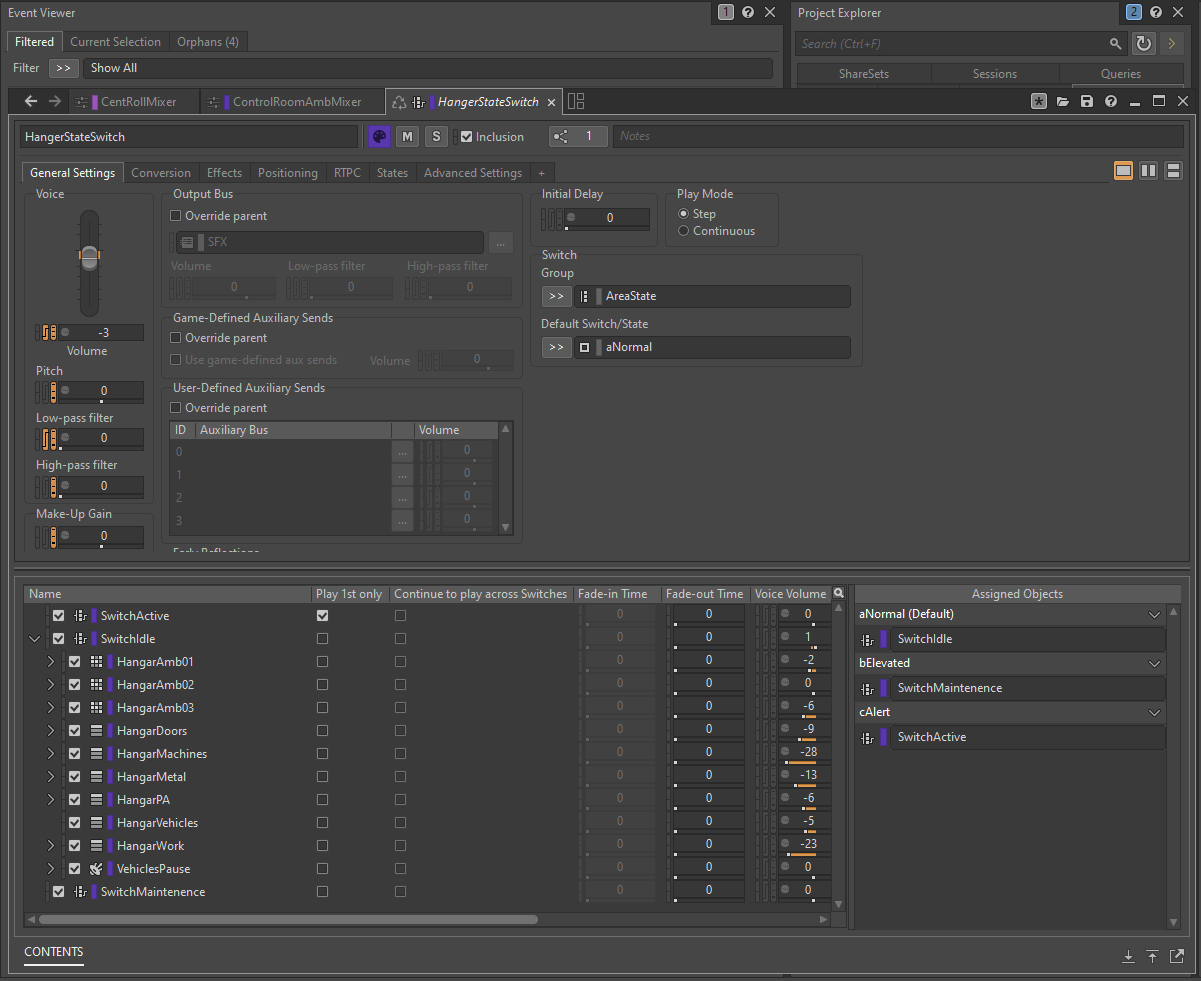
The hangar environment was divided into individual components including machinery, doors, metal activity, vehicles, work areas, PA announcements and underlying ambience.
Wwise states allowed the environment to change according to the operational state of the space, rather than remaining as a fixed background recording.
PA announcements were structured with multiple variations and pauses to reduce predictable repetition and create the impression of an active working environment.
WWISE · ENVIRONMENT SYSTEM
Ambience · Machinery · Vehicles · PA · Doors · Operational States
04
Ship Movement Systems
Parameter-driven sound designed around the physical movement of the ship.
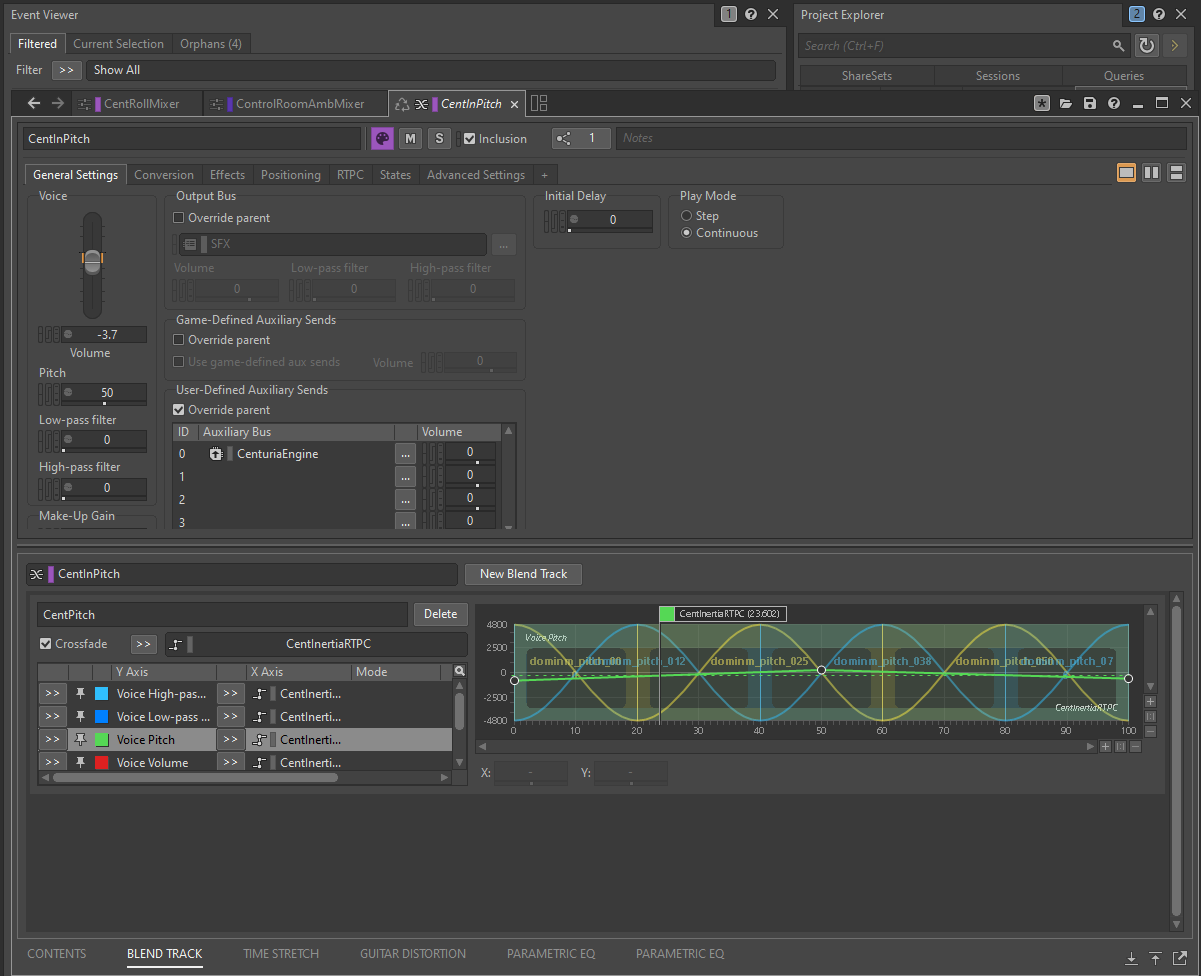
Ship movement systems were developed around runtime parameters including inertia, pitch, roll and yaw.
Wavetable-derived source material was distributed across Wwise Blend Containers and transformed dynamically using RTPC-controlled pitch, filtering and volume.
Crossfading between layers allowed the timbre to evolve continuously as movement parameters changed, rather than behaving as a single loop being simply pitched up or down.
These systems were developed and operational within Wwise, but were not integrated into the playable build before production ended.
WWISE · RTPC MOVEMENT SYSTEM
Inertia · Pitch · Roll · Yaw · Wavetable Layers
05
Engine & RPM System
A synthesised engine architecture driven continuously by RPM.
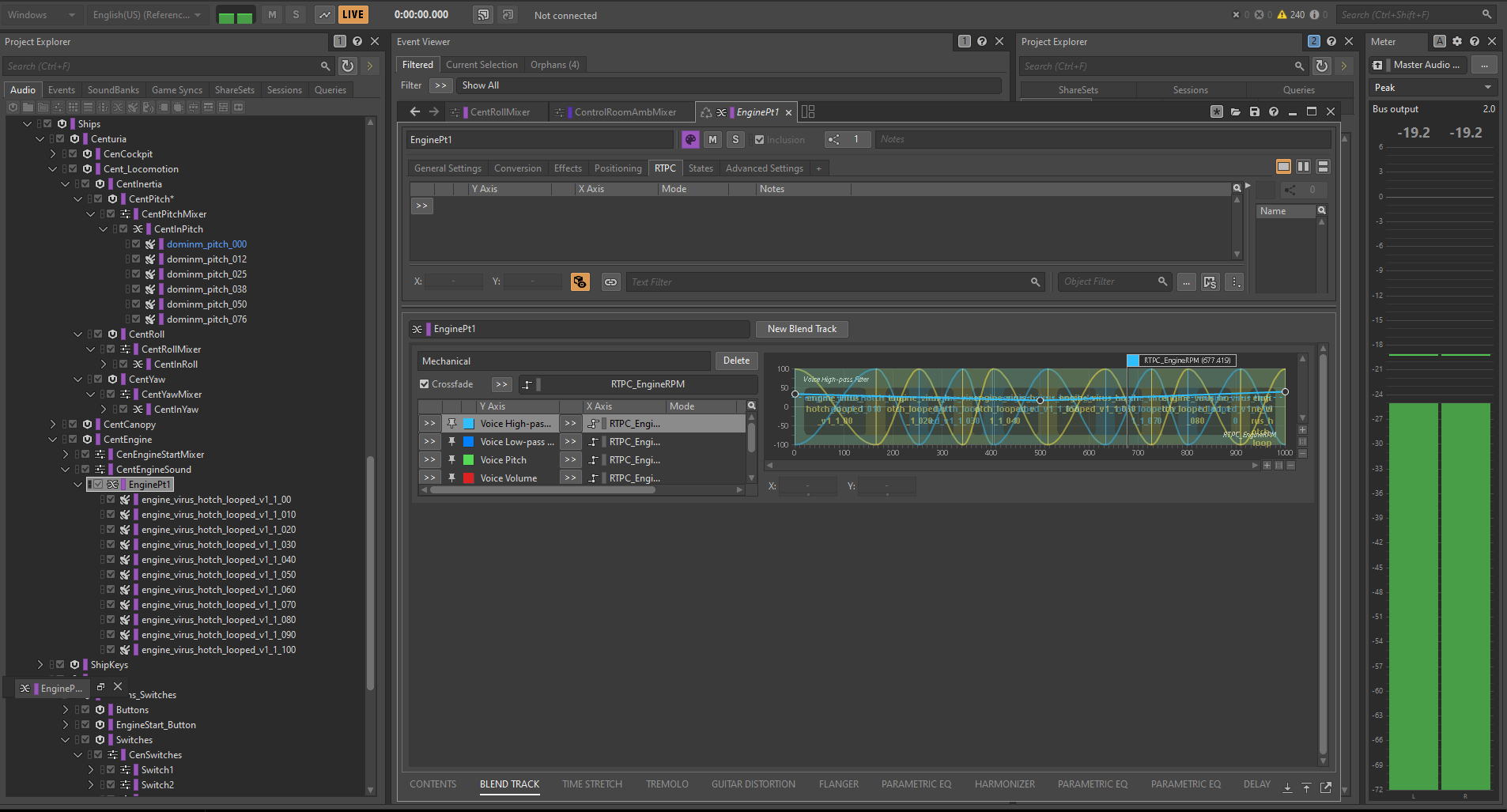
The engine system used a bank of synthesised source material distributed across an RPM range inside a Wwise Blend Container.
RTPC_EngineRPM controlled the transition between engine layers while simultaneously driving pitch, low-pass filtering, high-pass filtering and volume.
The result was designed as a continuously changing engine system rather than a collection of isolated one-shot or fixed-loop sounds.
The engine system remained a Wwise development system and was not integrated into the playable build before production ended.
WWISE · ENGINE SYSTEM
RPM · Blend Containers · Pitch · Filtering · Dynamic Layers
06
Game Sync Architecture
Game state and runtime parameters connected directly to audio behaviour.
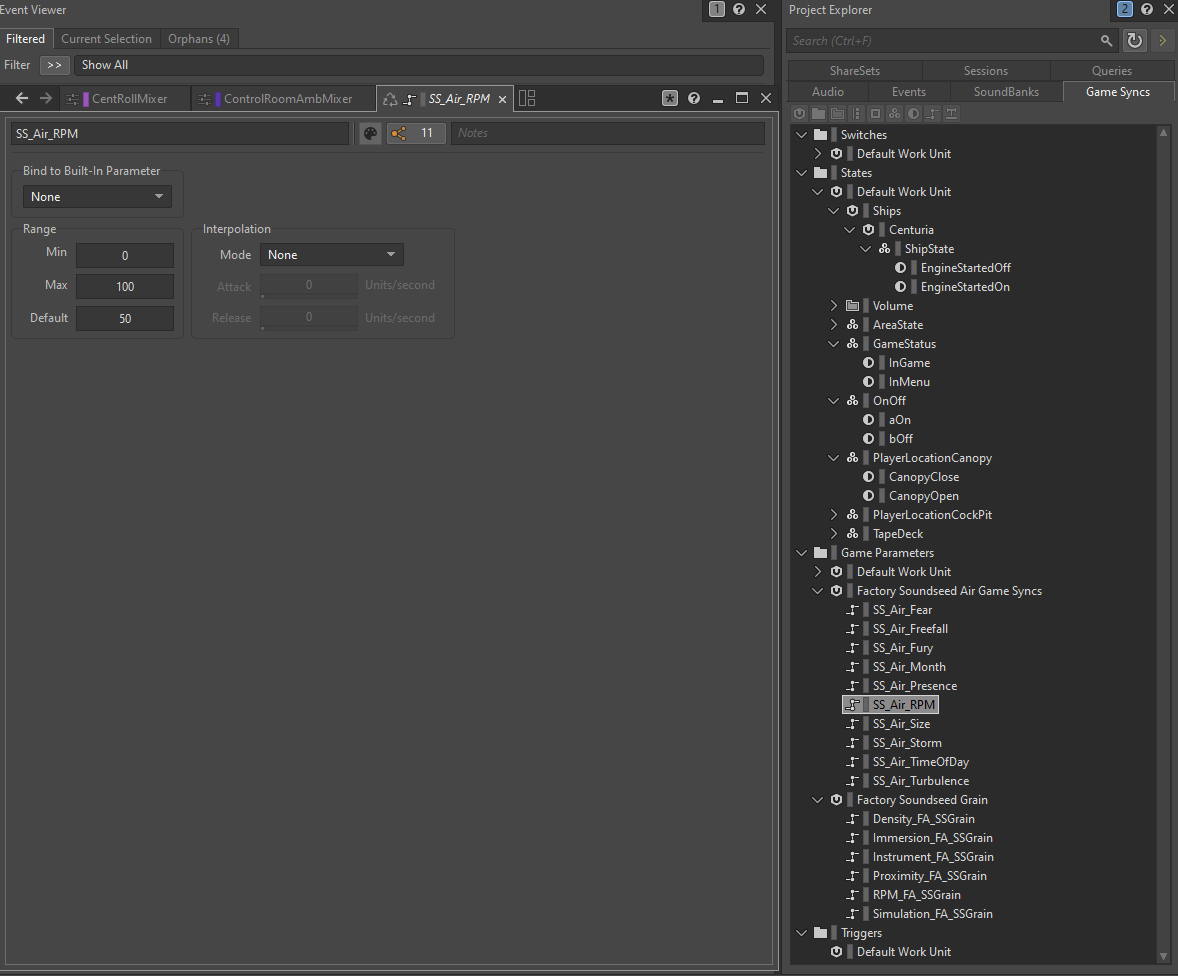
Wwise Game Syncs were used to organise the parameters, states and switches driving the project's interactive audio systems.
Parameters included RPM, turbulence, inertia and other environmental and simulation values, alongside states describing ship behaviour, player location and environmental conditions.
This architecture allowed audio behaviour to be designed around changing game data rather than fixed linear playback.
WWISE · GAME SYNCS
RTPCs · States · Switches · Runtime Parameters
07
Tools & Systems
SELECTED WORK